This Blog

Basically, these are my thoughts, opinions and experiences in the scientific world, more specifically the world of astrophysics. So if you like astronomy and astrophysics you're most definitely in the right place!

The name of my blog may be cliché 'infinity of possibilities before me' but that's what I see when I look up at the sky because there is so much out there that there really must be an infinite of possibilities (as long as they work within the laws of physics, of course).

And my title '1,429,400,000 km away'? That is my first post.

Enjoy...

Thursday, 3 December 2015

How to have the Most Amazing Time at the ESO Astronomy Camp 2015


European Southern Observatory

Congratulations! Félicitations! Felicitaciónes! Congratulazioni! Parabéns! Gratulacje! Grattis! Herzliche Glückwünsche! Felicitări! Gratulasjoner! Alf mabrouk! Tebrikler! Čestitam! (Apologies if I missed your language) you've been selected to attend the ESO Astronomy Camp 2015.

This camp has the ability to be life changing. It was the first time that I had surrounded by people who were as enthusiastic about astronomy as I am. It was the first time that I had seen a night sky without city pollution. It was the first time I tasted proper Italian hot chocolate.

So, from the 2014 and 2013 participants of the European Southern Astronomy Camp, here is our advice to have the best week you can:

1) If you can actually go to the observatory during the night, GO AHEAD! You don't know if the weather will be nice the next days. - Angèle, France, 2014 Camp

2) Bring heavy (thick) socks. - Francesca, Italy, 2014 Camp

3) If you have a camera, DEFINITELY bring it. If you have a tripod, YOU'LL REGRET NOT BRINGING IT. And secondly, BUY WATERPROOF/WINTER TROUSERS (NB: ski trousers work very well). You don't want your trousers to freeze... I speak from experience - Awnit, UK, 2014 Camp

4) Don't break your arm. - Luka, Germany, 2014 Camp (NB: this will be explained a bit later)

5) DO NOT volunteer to be interviewed for Italian television - you're most likely gonna end up not saying anything to the camera and just acting out some fake lecture/observation. Plus you're gonna muss out on some better activity (like a huge snowball fight or a warm dinner). - Cuba, Poland, 2014 Camp

6) Bring everything with you that keeps you warm and/or produces heat! Funny parlour games, lots of nerd jokes, CAS/math/astronomy tools. I planned to go out in the evening and lay/sit somewhere, look at the stars and listen to spacey music (Jean Michel Jarre, Stellardrone, Pink Floyd), but the cold said: Nope! - Luka, Germany, 2014 Camp

7) Games like Uno are a great way to make friends especially when used at every opportunity, even during dinner! - Katya, UK, 2013 Camp

8) Prepare something for awkward first meeting at the airport. Have some bad puns or at least try and talk to people.  - Klara, Germany, 2014 Camp (NB: There may be like 10 awkward minutes at the very beginning at the airport, don't be scared, don't be worried about seeming over eager, just talk to people.)

9) Don't expect to get a lot of sleep! Especially if someone brings a horse mask... - Benjamin, Denmark, 2014 Camp (NB: DIOGO. EVERYONE LOOK AT DIOGO.)

10) Bring lots of food to share! - Amy, UK, 2014 Camp

11) Don't be shy to talk to everyone, even if you won't be able to remember everyone's names! - Angèle, France, 2014 Camp

12) Forget about the star stuff and focus on having fun and meet new people who share the same passion and interest as you. You can always learn all of the other stuff later. - Frederik, Denmark, 2014 Camp

I'm just going to add a few pieces of advice myself:

1) Throw yourself into it. Make astronomy jokes, play card games and most of all talk to people! I've made invaluable friends from this camp because I talked to people!

2) Once the camp is over, don't stop chatting even if you start off by asking about the weather. I still have daily conversations with so many people from Camp, our Whatsapp group is still active with random jokes and astronomy discussions (nothing better than when Tommy starts asking all of us how to do his university work) and meet up with each other if you happen to be in the same city or country.

3) Look. You know that game where you stand in a circle holding hands and try to trip each other up? Ok, it seems like a fantastic idea at the beginning but when a fully grown guy lands on your elbow and you hear a snapping noise? Yeah. That game isn't a fabulous idea. BUT everyone signs the cast so it's all fine!

4) Bring amazing food with you! Cristina has asked you all to bring something from your countries, Turks bring turkish delight, Swiss bring some chocolate and Brits I personally advise bringing short bread. Tea time and snack times are so amazing because of all the food that you guys bring!

5) At some point it will happen. One person throws a snowball and at first only five people are involved and then suddenly there are fifty teenagers running around a field pelting each other with snowballs. Guys get involved in those snowball fights they are the best things ever.

So there is some advice from us to you. Feel free to ask me any questions in the comments!

All that's left to say is, from all of us:

Have an amazing time.
European Southern Astronomy Camp 2014 

Sunday, 19 July 2015

An Astronaut's Body

So recently my chemistry was told to write a chemistry essay on a topic that we chose from a list given to us by our teachers. I chose the title 'Chemistry on the ISS'... 

The essay I handed into my teachers, while not exactly what was asked for, was very fun to write!

So without further adieu, I present my chemistry essay: 'An Astronaut's Body'. 

Feel free to ask me anything in the comments!  

An Astronaut's Body
(Loosely based on the essay title: Chemistry on the ISS)
By Sophie Abrahams 


Introduction: 

The idea of traveling through the stars exploring strange new worlds, seeking out new life and new civilizations is one which has long captured the imagination of humans. The reality of what happens to an astronaut's body when they enter orbit is different to what one may think. Homosapiens have evolved on the Earth and thus our bodies are adapted to work under the gravity of Earth. Our bones hold up our body weight which created by the Earth's gravitational force. Our hearts function in a way which allows blood to flow against gravity to our brains and up from the legs to our hearts, as do other organs in the body which require fluids to go against the direction of gravity. We are used to a twenty four hour day, with one sunrise and one sunset, however astronauts experience multiple sunrises and sunsets every day. In this essay I will explore some of the affects of space on an astronaut's body, how they affect productivity on the ISS and how astronauts attempt to combat these changes. 


Affects of space on the bones of the Human body: 

On the ISS, astronauts cannot walk around the space station and instead float. This means that the bones of the body that normally support the body, especially those in the legs, are no longer being used as much. The reduction in weight effects the bone composition of an astronaut's body. 

Bones are made up from crystals of mineral bound to protein. This structure can absorb impact without shattering. The mineral in bones is a combination of calcium and phosphate called hydroxyapatite. A structure made up purely of hydroxyapatite would be too brittle and would break easily under pressure, not idea for bones which hold up the entire body even though they make up only 12% of the body mass in females and 15% in males.  A structure made up entirely of protein would be too flexible and soft, not suitable to support the body properly. A combination of the two creates a hard structure which can absorb shock without breaking.

If there is an insufficient amount of calcium in the body, calcium will be removed from the bones and circulated around the body as it has uses in blood clotting, nerve function and hormones secretion to name a few. A depletion of calcium in the bones weakens them. 

Bones are constantly reshaping themselves in response to the stress placed on them. If you go for a run every day them the bones in your legs will respond to the stress of running. They are restructured by two types of cells; osteoblasts which build new bone tissue and osteoclasts which destroy old bone tissue. In healthy bones, the rate at which osteoblasts build bone and osteoclasts destroy bone is the same, therefore the net bone mass remains the same (see Figure 1). However when you go into space and no longer place any stress on your legs, the bones of your legs respond. Osteoblast cell production is reduced while osteoclast production remains the same, which results in a net loss of bone mass.  
The bones most affected by decrease in osteoblast production when in space are the femur, fibula, tibia, pelvis and the lower vertebrae (see Figure 2). This break down in bone density is called disuse osteoporosis. 

When the osteoclasts destroy bone tissue the products are reabsorbed back into the blood stream. One of the main products is calcium. This calcium leaves the blood stream in the kidneys, along with other waste products from the body including urea, and can form kidney stones. Kidney stones are made up from balls of mineral crystals found in urine. They travel through the urinary tract and leave the body when urination occurs. 

Kidney stones cause sharp pain the lower abdomen, nausea, fever and pain during urination. They can pass out of the body naturally without pain or if they become stuck in the urinary tract ultrasound therapy can be used to break down the crystal structure. When calcium leaves the bones they become more brittle as a decrease in calcium leads to a decrease bone density. 

At the moment, it is hard to treat kidney stones while on the ISS and if astronauts' bones become brittle the chances of fracturing a bone increases which could jeopardise a space mission. Disuse osteoporosis begins within the first few days of space flight, the most severe loss in bone density occurs from the second to fifth month of living in space. Extended periods of time spent on the ISS have led to bone mass loss of as much as 20%. 

Research is being done into supplement pills which would help decrease the probability of developing a kidney stone while on the ISS and astronauts ensure that they exercise regularly and eat a diet rich in vitamin D to help combat disuse osteoporosis. Astronauts, once they return to Earth, do rebuild their bone mass as they place stress on their lower vertebrae and leg bones but it is a slow process. 


Affect of space on fluids in the Human body: 

Figure 3: Diagram of the superficial lymph nodes
in the female human body
The human body contains many fluids which are required for the body to function correctly, the two discussed in this essay are blood and lymph fluid. Blood contains white and red blood cells, platelets and blood plasma, the entirety of the body requires blood in order to function as red blood cells contain haemoglobin which carries oxygen. Oxygen is vital for aerobic respiration. Lymph fluid is a vital part of the immune system, containing white blood cells as well as collecting toxins from the body. These toxins, produced by cells, are filtered out of the lymph fluid in the lymph nodes. Lymph nodes are found in several parts of the body including the neck and armpits. Unlike blood which flows in a continuous loop through the body, lymph fluid flows in one direction: to the neck. Here it is filtered by the superclavicular lymph nodes and the cervical lymph nodes, where all waste products are removed from the lymph fluid. The remaining lymph fluid flows into the subclavian veins in either side of the neck. 

When on Earth, under the affects of gravity, the body has to work in order for blood to reach the brain and to return to the heart from the limbs. While the heart does not directly help lymph fluid move through the body, the natural movement of muscles aids the lymph fluid. However in space, the affects of gravity are not felt. The body works as strenuously as it did on Earth in order to circulate blood and lymph fluid around the body but gravity is not there to fight against the movement of the fluids. This causes fluid to leaves the legs and be redistributed in the upper parts of the body.

This causes astronauts' faces to appear 'puffy' as fluid which is not normally in the neck and head has been redistributed to those areas, lymph fluid in particular plays a part in this as it naturally flows towards the neck.  This extra fluid in the head can cause congestion of the sinuses. When fluids are redistributed from the rest of the body to the neck and head the size of astronauts legs can be affected. Astronauts legs have a smaller circumference in space than they do on Earth, partially because of muscle break down as they do not have to use their legs to move around but also, because fluids which were circulating in the legs have relocated to the upper body. 

Once astronauts return to Earth and are once again under the influence of gravity the fluids in the body will return to where they were. There is no way to prevent fluids from moving position in the body while in space unless an artificial gravity were to be introduced on the ISS, at which point bodily fluids would circulate naturally. 


Affects of space on Sleep and Performance of an Astronaut: 

Sleep patterns in space have been shown to be, in general, shorter, less restful and more interrupted than sleeping patterns on Earth. Sleep loss leads to fatigue which can affect the work productivity of an astronaut, as astronauts spend much of their time each day carrying out experiments. Astronauts also experience circadian desyncronisation. A circadian cycle is a naturally recurring 24 hour cycle which occurs with or without light fluctuations, such as sunrises and sunsets. 

Studies on sleep deprivation have shown that there is a a definite correlation between sleep deprivation and response times. In a study where subjects were allowed different numbers of hours in bed and then took part in a test where their reaction times were measured it was shown that those who had only 3 hours in bed per day (modeled as total sleep deprivation) performed with severe impairments to their reaction time while those who spent 9 hours in bed per day (modeled as an average night of sleep) did not have affected reaction times. 

On the ISS, where a study showed that 21 astronauts averaged 6.09 hours of sleep over 4,200 nights, when looking at Figure 5 one can estimate that with 6 hours of time in bed an astronaut's reaction time would be entering 'Impairment' (see the red cross on Figure 5). This is after 7 days with 6 hours of time in bed each day. After 3 months on this many hours of sleep one can extrapolate that an astronaut's reaction time, and therefore their performance, will have decreased. At the moment, most missions to the ISS last six months however one year missions are beginning as of March 2015, sleep deprivation will increasingly become a issue for astronauts as the length of missions increases. 

Desynchronisation from circadian rhythm also affects an astronaut's performance. Circadian rhythm is the 24 hour cycle which the human body is used to following. The body temperature changes as the circadian cycle occurs, it is at its highest during the circadian peak, which is when humans are most alert, and is at its lowest during the circadian minimum, which is when the body wants to sleep. Astronauts desynchronise from circadian rhythm while on the ISS due to lighting conditions, scheduling constraints as well as other aspects of the space environment. Lighting has a large affect on circadian rhythm, the ISS orbits the Earth every 1.5 hours, resulting in 16 sunrises and sunsets everyday. This means that the natural light the ISS is exposed to regularly changes, affecting when an astronaut's body is most awake and most asleep. 

Slam shifting, where the wake/sleep schedule of an astronaut is altered, is also a cause of circadian desynchronisation. Slam shifting occurs on the ISS before and after critical tasks, as well as docking and undocking of crafts. Slam shifting can result in loss of sleep and fatigue for astronauts. In 2,043 days of ISS operations Slam Shifts occurred 266 days, the shifts causing the astronauts to have to work when the their circadian rhythms were not at their peak. After the critical missions when astronauts attempted to sleep their circadian rhythm may have been at its peak, resulting the the astronaut suffering from more sleep deprivation. 

If astronauts suffered from this for one day, or even one week, it would be more relatable. However, at the moment, astronauts can suffer from sleep deprivation for six months at a time. This affects their well being both physically and psychologically. Astronauts Kelly Corniness and Scott Kelly, intending to stay 365 days on the ISS, may suffer from sleep deprivation for the entire year, and if they do it will greatly affect their performance. 

Astronauts regularly take sleep-inducing drugs to order to sleep, sometimes even taking two doses in one night in order to sleep. These drugs impair the ability to perform many tasks the day after use and yet sleep-inducing drug usage was reported on more than half of the nights before extravehicular activities, such as space walks, were undertaken. This places astronauts lives in danger, as space walks are very dangerous and an astronaut could easily be killed if they were not concentrating due to sleep deprivation or if they were still under the influence of such drugs. Therefore, sleep-inducing drugs is a very dangerous solution to the problem of sleep deprivation and is not the correct method for solving lack of sleep. 


Conclusion:

In conclusion, while space travel is presented in most media as romantic, the human body can be deeply affected by space. Sleep deprivation, continuous congestion of the sinuses and loss of net bone mass being a few of the many problems which astronauts face when they enter orbit. The human body has evolved to function at its peak on Earth, where there is a constant gravity and constant light fluctuations, not in space. If we wish to advance space travel it is vital that solutions to these problems are found, or long space missions may not be possible due to astronauts bodies not being able to survive a mission of two or more years.  


Saturday, 6 June 2015

'Hannah's Sweet Question'


So, my exams finished yesterday (well all but one, but we'll ignore that S2 exists shall we?) and on the theme of exams, yesterday I saw the 'evil' 'Hannah's Sweet question' which stumped some GCSE Edexcel students earlier this week. 

During an exam, when you're working like crazy against the clock to finish the paper, it is very easy to panic when a question is unlike any you've seen before. 'Hannah's sweet question' is a combination of algebra and probability which is why, I think, it stumped some GCSE students.

My solution to 'Hannah's Sweet Problem': 


On first sight, this question looks horrible. But if you think about it, scribble a few things down then the answer becomes clear.


Drawing a tree diagram to show the probabilities of picking two oranges sweets, an orange sweet and a yellow sweet, a yellow sweet and an orange sweet or two yellow sweets helps make the question clearer. The important part of the tree diagram is circled in white.

We're told that the probability that Hannah eats two oranges sweets is 1/3. By drawing a tree diagram we can see that the probability of eating two oranges sweets is 6/n multiplied by 5/n-1.

The probability of getting an orange sweet the first time is 6/n because there are 6 orange sweets and a total of n sweets she is choosing from.

The probability of getting an orange sweet the second time is 5/n-1 because, if she has taken an orange sweet the first time then, there are only 5 orange sweets left and there is a totally of n-1 sweets left in the bag.


And there you have it, the solution to 'Hannah's Sweet Problem.

The key to doing this question is to stay calm. If your immediate reaction to a difficult question is 'oh my gosh, how am I meant to do this?!', then not only will you not be able to do the question you're stuck on but you will have problems with the rest of the paper because you're in a panic.

Any questions about the method, ask me in the comments! 

Friday, 17 April 2015

Science and Taylor Swift. Does life get better? 


This video actually makes a real point. Science is responsible for the internet, iPhones, the bus you take to work, the escalator you use to get to the top floor of your favourite shopping mall.

Don't go dissing us science geeks.

Thursday, 22 January 2015

ESO Astronomy Camp 2014-2015 

Or: The Best Week of My Life 

All of us looking our best
I was going to write up an account of the week day by day, but due to school being something that exists and my arm still not really working properly I decided it would be a better idea to summarise it. That and you probably don't want a minute by minute account, if you do then let me know. 

Having said I would summarise the experience
I honestly have no idea where to start, there are so many highlights from the week. So here are my top five (they were very, very, very hard to pick) highlights from the ESO Astronomy Camp 2014-2015. 

5) Getting Up at 5 am to See Saturn: 

Jupiter with its four major moons
One morning a group of us woke up at five (Ok, it was closer to six but five sounds more extreme) to do an observation of Saturn. Having put on as many layers as we possibly could, wearing four pairs of socks (or three if you were feeling particularly brave) 30 of us headed to the observatory, head torches lighting the way. We had a quick look at constellations before turning the telescopes towards Jupiter. We were able to see Ganymede, Io, Europa and Callisto as well as the stripes which ring around the equatorial region of Jupiter. We tried to do an observation of Saturn but due to turbulence in the atmosphere we could only just make out the planet's rings.

Quick explanation of turbulence: the Earth's atmosphere is made up of layers of different gases, the gases in these layers move around. The movement of the gas molecules distorts the image you see through the telescope. The windier it is the more the molecules move around and the more the image is distorted.

When we tried to observe Saturn, not only was it windy but, we were looking at it from an angle where we were looking through a thick part of the Earth's atmosphere which prevented us from getting a good image.

Having decided to tell everyone who didn't get up early that we saw Saturn in epic detail and they should be very, very jealous of us, we headed back to breakfast and a day of awesome lectures. 

I believe this was taken just before snow started to fly...

4) The First Snow Fight 

Left, right and centre I had managed to make enemies. What had started off with me and one of the other girls saying to three people 'Let's have a snow ball fight!' had turned into forty teenagers running around a snowy hill laughing, screaming and throwing colossal amounts of snow at each other. 

Long distances missiles were thrown by some, a few managing to hit me right in the head. Others, like myself, went for the approach of walking up to our target, calling their name and then chucking the snow right in their face as soon as they turned. There was even one moment when one of the boys was juggling snowballs, I waited for the opportune moment and then hit him right in the face. 

I do feel guilty about that.


3) New Year's Eve 

New Year's Eve Dinner... Pinecones may have been thrown
Admittedly waking up at eight on New Year's Day, having slept only four hours, was a horrible feeling. But I wouldn't have spent New Year's Eve any other way. We did an observation dressed in our fancy New Year's clothes, entered the new year with three different traditions (Spain: we ate a grape on each stroke of midnight, Denmark: we all physically jumped into the New Year and Italy: we made a toast), made snow angels at midnight, set off fireworks and ran around hugging each other yelling 'HAPPY NEW YEAR!' Our four awesome supervisors had organised for everyone to have a piece of paper with their names on pinned up on the wall and as Vania (one of the creators of the rap song I previously posted) started DJ-ing we all wrote on each other's pictures.
My epic piece of paper

Prize for the best comment on my paper goes to Federica who wrote 'For your future - break a leg XD' (it's funny in the context that I fractured my arm on the camp).


2) Lectures

Standard Candles and how they're used to help calculate distances, measuring the distance to the moon, the spectra of stars, the H-R Diagram and parallaxes (everywhere parallaxes). That is just a snapshot of what we learned in lectures. Every morning when I walked into the lecture room I knew I was going to leave having learned something fascinating that I would use in the future. 

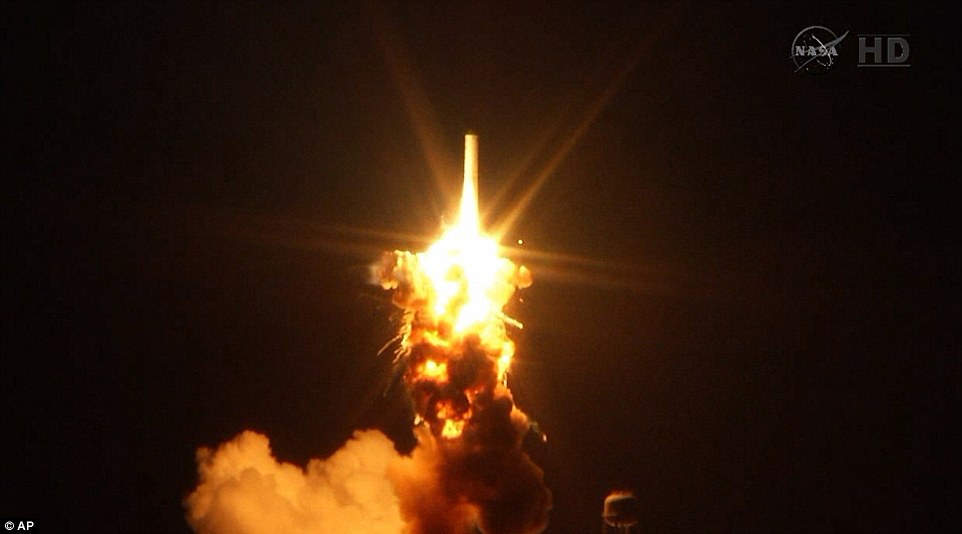
Luckily Gaia didn't go wrong like the last Antares rocket
I came to have an understanding of what astronomers measure when they look at stars and how the data from these measurements helps us unlock the secrets of our universe. I learnt about how long it takes for space missions, such as Gaia, to actually get off the ground and into space. The mission was first conceived in 1997, when I was born, and was launched into space when I was fifteen. Imagine taking a machine you have spent more than a decade designing and strapping it to explosive rocket...

1) How Many Stars I Could See

On the first evening, having arrived and unpacked our bags, we went up to the observatory to have a look around. As we left the hostel I saw something in the sky out of the corner of my eye. I looked up and my jaw dropped.
The European Southern Observatory
Remember that I live in London. Where it is often so cloudy you can't see the moon, let alone stars. Where there is a huge amount of light pollution. Where, when it's really clear, you're lucky if you can see Arcturus, the belt of Orion and Sirius.

I looked up and my jaw dropped because I could see the outline of the Milky Way stretching over us. I could see Orion, Ursa Major and Sirius. Jupiter was so bright at first I thought it must be an airplane. I hadn't seen the sky filled with so much light before. It is very easy to forget about the night sky when you live in London because you simply don't see it. I felt connected to the sky and to the world around me, it was wonderful.

It is a sight I hope I get to see again one day.


So there are my top five memories from ESO Astronomy Camp 2014!

The view I woke up to every morning for a week... 
And that's not including when we froze our hands off taking the spectra of stars, the trip to Matterhorn, taking a group photo and then having to retake it because we missed someone, having everyone sign my cast after I fractured my arm, trying and failing to cross-country ski, playing Chinese Snap and breaking a table cloth because the game got so violent, the ESO X Factor, marking on a map where everyone was from and trying to figure out who had come from Antarctica, playing incredibly stupid game involving standing in a circle and holding hands while trying to try each other up which didn't end very well, eating breakfast, lunch and dinner with 55 incredible people and waking up to see the sun rising over the snow covered mountains.


Thank you to the European Southern Observatory for organising a life changing week, thank you to our amazing supervisors Vittorio, Emily, Tommy and Ruth and thank you to the Science and Technology Facilities Council for awarding me with a bursary to attend the camp.

Last, but definitely not least, thank you to Ramón, Gonzalo, Sophia, Andelka, Tomasz, Anga, Fabian, Camille, Diogo, Gustavo, Gonzalo, Ali, Awnit, Lena, Luka, Vania, Gianluca, Marian, Marielle, Laura Angélica, Allan, Aideen, Maja, Federica, Mikolaj, Raven, Desmond, Kuba, Benjamin, Margarida, Francesca, Eleonora, Femke, Baris, Mohammed, Jakob, Klara, Angèle, Felisberto, Gemma, Daniele, Leonardo, Baran, Klaudia, Michal, Gonçalo, Mariona, Elias, Gerard, Indira, Jenny, Nicola, Jess, Frederik, and Amy.

Without you guys this experience wouldn't have been what it was, I hope to meet all of you again in the future.

 I look forward to when one of us wins a Nobel Prize because whoever does has to throw a party and invite everyone else from ESO Astronomy Camp 2014-2015!

We came from 22 countries. From Hong Kong to Brazil, from Egypt to Sweden. 

Credits for the photographs used go to Amy Palmer, Awnit Singh and Allan Costa


Tuesday, 6 January 2015

ESO Rap 

Unfortunately I haven't perfected the art of typing with one hand yet.

So instead here's a rap video Vania and Gianluca, two of my fellow participants who are both from Switzerland, made about the ESO Astronomy Camp 2014/2015.

They summarise wonderfully what made the week so magical: 'People from many different backgrounds, but all have one thing in common: a passion for astronomy'


'Good bye' is an awful word to use guys! I'd really like to think we'll all find a way to meet up again... 


Saturday, 3 January 2015

I'm back from the ESO Astronomy Camp 2014! 

It was such an amazing week, I never wanted it to end. I miss everything about the camp and I miss everyone from it. 

There's so much to say that I'm going to have to go over the camp day by day, telling you the highlights. I can't go into too much detail though, I almost put my parents to sleep while telling them about the week!

So here are just a few of the highlights. 

We stuck signs on each other's backs: 

'Don't approach. I'll bite you!'
'I like unicorns'


'Kick me'
'Don't approach. I'll bite you!'
Don't approach. I'll bite you!''


Don't approach. I'll bite you!'


We used our calculators to make cool shapes: 


In the evenings we were awed by Benjamin's Rubix Cube abilities: 


We ran up and down hills: 


(And y'know, I fractured my arm.)

But everyone signed it so really I didn't mind fracturing it in the first place. 


More to come when I have perfected the art of typing with one hand!