Moons and why they are generally awesome.
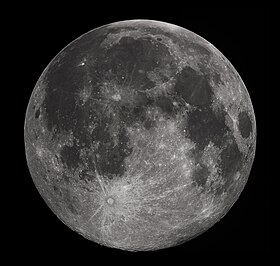 |
| Our very own moon, Luna |
For us on Earth, the moon is a normal feature of life. It's always there at some point or another. But imagine if we had no moon. The night sky may look a little bit less romantic, sailing would get a bit harder without a high tides and what would we ever do with our lives if we didn't have Taylor Lautner ripping his shirt off on our TV screens?
If the idea of a planet's night sky without a moon sounds lonely to you, fear not. All planets in our solar system, except Venus and Mercury, have moons. Which makes me feel very sorry for the two innermost planets in our solar system because what planet doesn't deserve a moon?! These things are awesome!
 |
| A Cassini Image of Titan (the blue tinge around the outside of the moon is its dense and thick atmosphere) |
So how do moons form? Well, I was doing some research into how our moon formed on NASA's website. While NASA didn't seem to be able to tell me how our moon formed, it reliably informed me that, and I quote, 'The moon has no moons.' Thanks NASA, I never would have guessed that one.
We don't have a confirmed theory for how our moon formed, but what we do have is a widely accepted theory. We believe the moon was created when a object about the size of Mars slammed into the newly formed surface of the Earth a few billion or so years ago. This turned the Earth molten again and material was ejected into space during the collision. Some of the material fell back to Earth but the rest of it collected together to form the moon.
So that (kinda) explains the formation of our moon. For now we can't be sure how any moon forms, but what we can do is study them as much as possible. Which is where the proper fun starts.
Planets come in wonderful, wild and wacky variations, rocky or gaseous, ringed or un-ringed, with atmospheres or exposed to space. But there are only eight planets (and a dwarf planet) in our solar system so we don't have very many to study (not that we need many more for the time being, we have our hands full with Saturn's rings, Mars' water and debating Pluto's place in life). However moons. Oh, beautiful and bizarre moons. There are 146 confirmed moons in our solar system and they are just as fascinating as any planet.
My favourite moon? Enceladus.
 |
| A Cassini image of Enceladus (note the faint but visible water jets at the south pole of the moon) |
This is the moon that sparked my interest in astronomy and space. And there's a good reason why it did. Not only do liquid water geysers shoot from its surface into space regularly, but it is thought to be what is forming the entire E ring of Saturn's rings. The whole ring is made up of debris that has come from Enceladus. This moon has a diameter of 504 Km, which is only slightly smaller than the length of the UK, and it's forming a ring that is approximately 470,000km in diameter. It also has one of the highest albedos in our solar system (albedo is how reflective an object is) with an albedo of almost 100%.
So these things make it pretty cool but what makes this planet amazing is that the liquid water present on Enceladus could be home to single celled organisms. When I tell people about this moon face to face this is normally the point where I start flailing around like a five year old and talking faster and faster. You can see the effect it has on me. And you may think, 'So what? It's only single celled life. It's not like you just found E.T. or Spock.' But if we can find life present on two bodies in one solar system (on Earth and on Enceladus) then the chances of finding life in other solar systems increases a lot. If we find simple life in other solar systems eventually we simply have to find complex life.
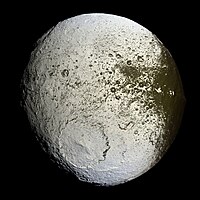 |
| A Cassini image of Lapetus (the dark patch on the right is the beginning of the black part of the moon) |
Moons are wonderful things because of the variety in our solar system.
In our solar system moons are much more common than planets and every single one is different. For example, the moons Lapetus and Nereid. Lapetus is half black and half white (quite literally), the black crust on one side of the moon only about a metre thick and is thought to have been swept up by the moon as it orbited Saturn.
In contrast Nereid has the most eccentric orbit of any moon in the solar system, it flies out more than 9 million kilometres from Neptune before swooping within 1.4 million kilometres of its parent planet. Nereid would not be unusual in this respect however moons which have eccentric orbits similar to the orbit of this lumpy moon are normally asteroids or comets which have been captured by their parent planet's gravity. Nereid does not share this trait, its composition doesn't resemble that of the various comets are asteroids in our solar system. While we believe that Nereid formed from the disc of leftover material orbiting Neptune after the planet's creation, its bizarre orbit is still a mystery to us.
We simply don't get the same variety in planets that we do in moons at the moment. Moons are a hell of a lot more accessible than planets are due to the fact that after we reach eight planets (and a dwarf planet) the nearest known exo-planet is about twelve light years away from our solar system. You may think 'Twelve?! Doesn't sound so bad!' But light travels 299,792,458 metres per second (yes, I know that number off by heart) meaning that one light year is a distance of 9.5 trillion kilometres. It is hard to comprehend a distance that large.
The nearest moons to us, after Luna, are a mere 56 million kilometres away from Earth and orbits around Mars (Phobos and Deimos).
So the conclusion you should take away from this is that moons are awesome and not to be under-appreciated. They come in so much amazing variety and can teach us so much about the world around us and the universe we live in.
So next time you see the moon gracing the sky above you, give it some love would you?

No comments:
Post a Comment